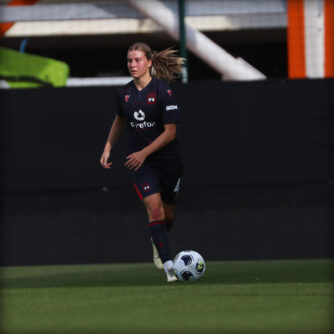
Ceri Norris gives an overview of ACL injuries and why it has more impact on the women’s game. With the help of real case studies from Llangefni’s Jess Jones and Aberystwyth’s Amy Jenkins, Ceri gives an insight into the mechanics and impact of this injury.
What is the ACL and how has it affected athletes?
The ACL (anterior cruciate ligament) is a short, thick powerful ligament which is attached to the thigh and shin bones. In recent years ACL injuries have become a growing concern, more so for female footballers. Since 2022, over 500 ACL injuries have been recorded – in January 2024 alone, 195 professional athletes suffered an ACL injury keeping them out of the game for over 18 months. A shocking statistic states that women are up to 6 times more likely to suffer from an ACL injury, with almost 30 athletes missing out on the 2023 Women’s World Cup!
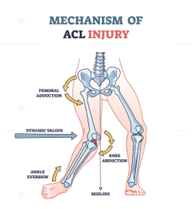
Compared to every 1/50 men, a staggering 1/29 women tear their ACL’s. Andy Williams suggests that it may be due to the angle of the tibia bone, as they have less curved legs than men – as well as a possible smaller notch in the women’s knee. He states that “Women do have a significantly higher risk of an ACL rupture” and a loss of 1/3 of playing time due to the injury.
Why does an ACL injury happen?
ACL injuries tend to happen due to increased workload, travel and insufficient rest that players suffer from. Muscle strength imbalances, environment and biological factors are seen as main factors. They often occur due to changing pace or direction as well as repetitive landing and pivoting manoeuvres. Therefore, contact between two players isn’t often the cause for this injury.
An ACL injury is often separated into 3 Grades, with a complete rupture (Grade 3) requiring surgery. ACL tears often take 9-12 months before fully healing, yet many players never return to play again. It is researched that 25% of female players, who suffer an ACL tear, are less likely to make a full recovery from the injury and return to the pitch – in comparison to male footballers. Some argue, that due to the lack of research regarding the injury in female players, there is less resources accessible for treatment. Others disagree, believing that it is because of the female physique making it harder to be fully treated.
Famous footballers who have suffered from the injury…
Iconic stars across the top flights of football have suffered with an ACL injury across many years. The injury has become more known, as players like Chelsea’s Sam Kerr and England superstar Beth Mead have undergone surgery. Aussie legend Sam Kerr was out of action for 20 months with an ACL injury which from January 2024. Wales star Sophie Ingle had to miss out on the 2025 Women’s Euros playoffs due to her ACL rupture. It is possible for a secondary ACL injury to happen after recovery. In recent news, Bayern Munich midfielder Lena Oberdorf has torn her anterior cruciate ligament for a second time. The midfielder suffered her first injury when playing for Germany in June 2024 and again, a month after her return in 2025.
ACL injuries in the Cymru Leagues
A massive thank you must go to both Amy Jenkins and Jess Jones for their support and stories when writing this article. Jess Jones, who plays for Llangefni Town suffered an ACL injury at 19 years old and has gone on on to fundraise for her own treatment. Amy Jenkins, an Aberystwyth Town legend suffered the injury many years back, but still remembers the long process it took to the worthwhile recovery further reflecting the growing concern in the women’s game over this career ending injury.
Jess Jones’ ACL journey.
“Several months ago, I experienced an injury that I’ve never had before. After countless hospital visits and waiting weeks for scans. After being told it was nothing twice at A&E, my parents and football manager decided it was best for me to go private so I could see what it is and hopefully sort it with physio!
But unfortunately, I got a phone call from the hospital which said I had torn my ACL – the last thing I wanted to hear, with so much to look forward to this year in football; as I was offered a scholarship in the US and having a place in the international island games team being taken away just like that.
It’s been really hard for me mentally, as it’s the only thing I’ve known from the age of about six – always having a ball at my feet, spending countless hours on the field and never missing a training – to not having the choice has just been really tough.
Seeing others documenting their journey has helped me a lot since finding out, as it has given me hope for the future and made me feel motivated for my recovery. My parents have been my biggest support throughout this by offering to pay for my operation, but having a younger sister they also support, I thought it was best that I set up a GoFundMe to take that pressure away from them and hopefully raise the money needed to get the operation I need to start back on my journey back to football.
I think staying in touch with football, being on the side supporting and feeling included is the biggest thing for me to help get through it. I feel the past few weeks have been difficult, but I’ve found out a load of new things about myself such as new hobbies I can do to pass the time, which has been nice.
Everyone from my friends, family and even strangers have given me amazing support, by sharing and donating the Go Fund Me page and helping me reach my goal of getting back on the pitch 100 times stronger! The one thing that’s motivating me the most is the feeling that I’ll feel scoring that first goal after coming back!”
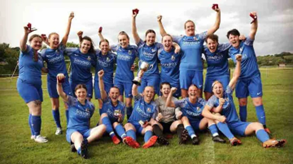
Llangefni Town, Jess Jones’ team in which the young star has scored 83 goals in 50 appearances before her ACL injury in February 2025.
Photo from Jess Jones’ GO FUND ME PAGE:
Fundraiser by Jessica Jones : ACL injury – journey back to football⚽️
Amy Jenkins’ life changing experience regarding her ACL injury…
“Tearing my ACL at 20 years old changed my life as well as my experience in football forever. During the beginning it was one of the most nerve racking and unsure period I had been through in my young life (at the time).
The diagnostic to begin with was a partial tear. Good news? Not really; one year later a wrong-footed twist and that horrible noise happened again. If anyone has torn their ACL before then they know what I mean. YOU JUST KNOW. You know when it happens, it is unexplainable, you just know that it’s not good. “
Legend Amy Jenkins suffered an ACL tear at 20 years of age and is now back playing for Aberystwyth Town FC and has been named captain for the 2025/26 season.

Image from Aberystwyth Town captain Amy Jenkins on season start
“It’s weird but looking back, I can’t remember hearing those dreaded Grade 3 ACL tear words spoken by my doctor when discussing my MRI results. The only thing I remember is from that appointment was thinking, “Here we go, will I ever get back from this”. Football had been my life since I was 6 years old. My dad played football, my brother plays football and my mum coach’s football. How am I going to be able to watch them play football when I may never be able to get back again? To be honest, I didn’t. My way of coping with the diagnosis was let’s just not think about football. I removed myself from our teams group chat, I stopped watching local football teams and I even refused to check up on any scores or watch football on TV. Maybe a bit dramatic looking back. But at the time, it is what I needed.
After the acceptance that this has happened, and I need an operation to fix this. The next worry was “When will I be able to get this operation done? Do I even get it done? Is my football playing days over?”. Lucky enough for me, with my family’s support, we ended up paying for my operation and going privately. With the recovery times being 12 months post operation, we decided the quicker it gets done the better. Usual waiting times are 12 months for an operation itself. With paying for it, I only had to wait 3 months. At this time, there was no financial support available for an issue like this. The professionalism of the league and the clubs in the league during this time was seriously lacking. Something that has improved drastically over the past few years.
Alongside not having much support, I made sure I did my own research around ACL injuries and different surgeons that use different types of graphs. Discussing with close friends that work as physios and specialists, I concluded I wanted a surgeon who would use a patellar tendon graph. Historically, a graph with quicker healing speed, greater strength with a low risk of stretching. However, this causes more anterior knee pain. No pain no, gain right?!
Surgery for me at the beginning, was very painful to say the least. Waking up from that operation was something I will never forget. The three-hour drive home the same day is another thing I will never forget. Choosing a patellar tendon graph has its benefits, however, the closest surgeon within our price range was Cardiff. Being from and living in Aberystwyth sometimes comes with its negatives. Being far away from everything is one of those negatives.
Surgery done and, on the mend, right?! How about throwing a curve ball?! Rehab felt like it was going well for the first few weeks. However, lack of extension and a screw unscrewing itself in my shin meant my body had different ideas!! Second surgery needed!! All that hard work down the drain!! However, I woke up from the second surgery in a lot less pain than I fell asleep in, Result!!!! Back on track?!!
Then Covid happened ……… football suspended!!! Lucky for me my operation had been done! However, if I had waited the 12 months on the NHS it would have been delayed due to a worldwide pandemic. So, I counted myself lucky.
After many physical and mental challenges with this injury. 2 years and 6 months later …. I finally made it back on the football pitch. With countless hours spent a day, the hard work of all my physio’s and family/friends, all came down to this moment. All the hardships since the injury, little did I know that the real mental challenge had just began!! Many questions went through my mind, “What if it goes again?”, “Can I put myself through another ACL injury?”, “Will I still be good enough?”. With reinjury rates being historically high for ACL injuries, I did think about not returning. However, football has and always will be an important part of my life. Lucky enough for me after this injury I have manged to get a pretty good career out of it. Playing and proudly captaining my local town club of Aberystwyth at the highest level in Wales!! It made all the ups and downs of this type of injury worth it. If I had to go back and change it, I most probably would, but I know I wouldn’t be half the footballer or half the person I am today”
CONCLUSION
More research needs to be done to help prevent this continuous and worrying injury in the women’s game, while a bigger support system needs to be created to help those suffering with its effects…